Essay · 8 min read
The Psychology of Space
People judge a room in moments, long before they can say why. Environmental psychology has spent fifty years measuring what the body notices first — and it is rarely what a mood board is built around.
Prospect and refuge
In 1975 the geographer Jay Appleton proposed that we instinctively prefer places that let us see without being seen: a clear view out (prospect) from a protected position (refuge). It began as a theory of landscape. It turns out to describe interiors just as well.
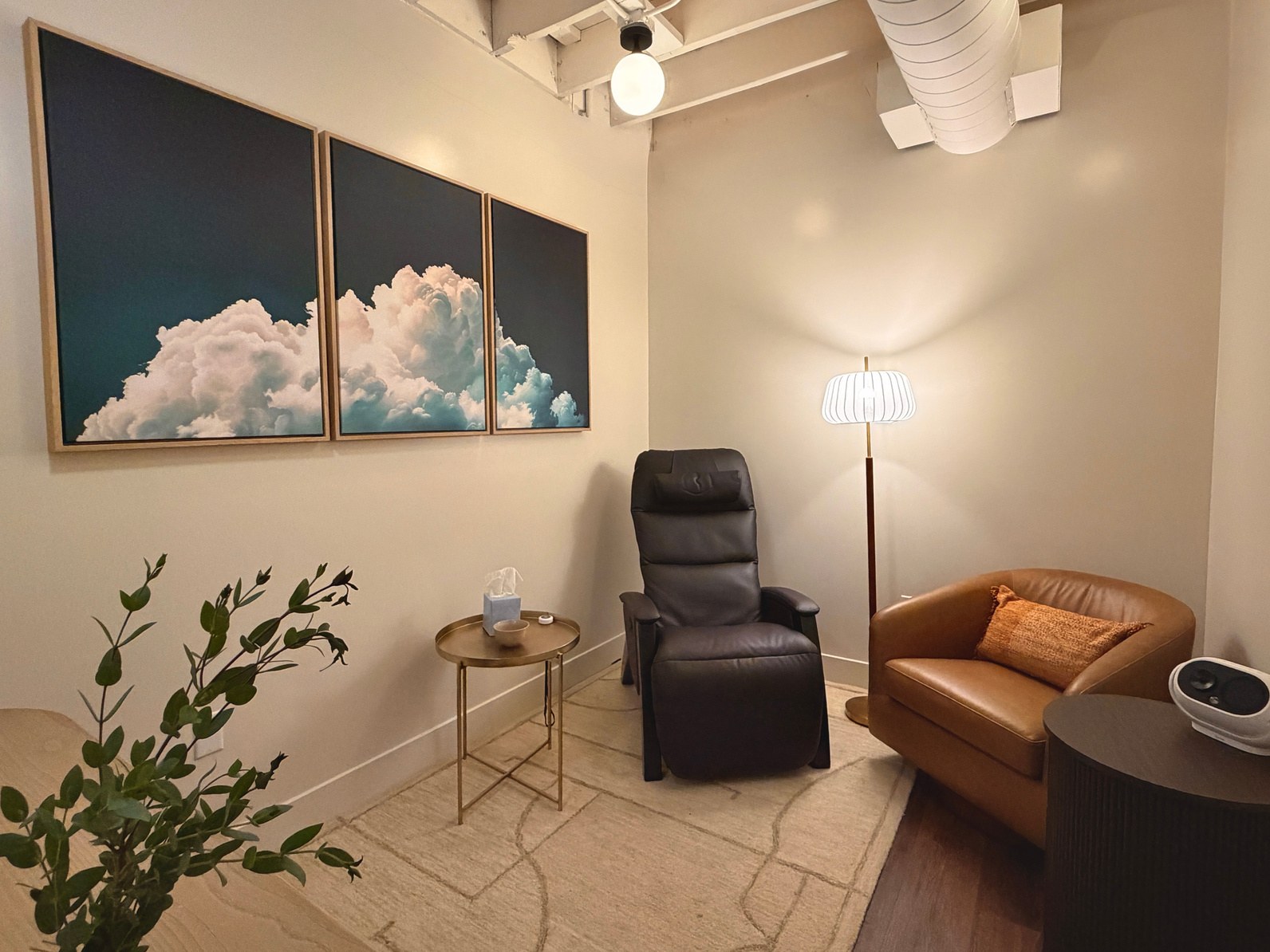
Watch where people sit in an empty café. The first seats taken are almost always those with a wall behind them and a view of the door. In a waiting room, the same instinct becomes anxiety when every chair faces the entrance in an open row. Nobody complains about it. They simply never relax.
Curves, ceilings and the unconscious verdict
Bar and Neta (2006) showed participants pairs of objects that differed only in their contours. People consistently preferred the curved versions, and the researchers suggested that sharp angles may carry a faint signal of threat. Later brain-imaging work by Vartanian and colleagues (2013) found that curvilinear rooms were more often judged beautiful than rectilinear ones.
Ceiling height changes how people think, not just how they feel. In a series of studies, Meyers-Levy and Zhu (2007) found that higher ceilings nudged people toward freer, more abstract thinking, while lower ceilings encouraged focused, detail-oriented processing. Neither is better. Each should be chosen on purpose: a consultation room and a creative studio want different things from the same dimension.
Attention as a finite material
Rachel and Stephen Kaplan's Attention Restoration Theory holds that directed attention tires, and that certain settings — especially natural ones, with 'soft fascination' — let it recover. A room full of competing signage, screens and clutter spends a visitor's attention before they have done anything at all.
This is the quiet argument for restraint. Minimalism is not the point. The point is that every object in view is spending something.
For your space
- — Give every seat something solid behind it and a view it can choose.
- — Treat ceiling height as a decision about how people will think.
- — Count what competes for attention at the threshold, then remove half of it.
Sources
- 1.Appleton, J. (1975). The Experience of Landscape. Wiley.Origin of prospect–refuge theory.
- 2.Bar, M. & Neta, M. (2006). Humans prefer curved visual objects. Psychological Science, 17(8).Preference for curved over angular contours.
- 3.Vartanian, O. et al. (2013). Impact of contour on aesthetic judgments and approach-avoidance decisions in architecture. PNAS, 110(Suppl 2).Curvilinear interiors judged more beautiful.
- 4.Meyers-Levy, J. & Zhu, R. (2007). The influence of ceiling height. Journal of Consumer Research, 34(2).Ceiling height and styles of thinking.
- 5.Kaplan, R. & Kaplan, S. (1989). The Experience of Nature: A Psychological Perspective. Cambridge University Press.Attention Restoration Theory.